
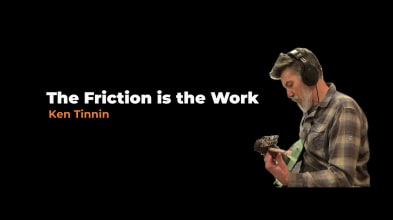

For many years, I ignored the friction I was experiencing at work. At first it was small, isolated to specific tasks, but soon it spread, and before I knew it, every aspect of my job was difficult, frustrating, or stressful (sometimes all three). I wrote it off to growing pains. I was in a role that had never existed before. I had little to no formal training—I was figuring it out. It will take time, I told myself.
Then little things started happening outside of work: difficulty sleeping, sometimes not sleeping, and the all-too-familiar dread of Monday. Soon, dreading Monday became dreading Tuesday, Wednesday, and so on.
My first solution was to work harder. Maybe it’s me, I thought. Maybe I’m not doing enough. So I worked harder. At the time, I was deeply entrenched in a self-directed personal development program. I searched for answers in books like Extreme Ownership, The Daily Stoic, Getting Things Done, and Eat That Frog. I embraced the concept of taking complete responsibility not just for my actions but for the situation itself. I learned how to separate what I control from what I do not (two simple concepts in theory, but ones I still struggle with today), and how to organize my personal and professional life.
I read every morning before work and listened to similar-themed podcasts during my commute to and from work. Initially, this helped. I felt focused, driven, and empowered. But this soon faded—sometimes theory only takes you so far, especially when it slams hard into reality. I was soon back to dreading work. Even the simplest tasks seemed daunting again, and I was developing an adversarial relationship (in my head) with work. I was deeply unhappy (a very generic feeling that in hindsight, I should have dug into more), and this unhappiness spread into other areas of my life.
My next idea was to do more outside of work—if I can’t find happiness or fulfillment at work, maybe I can find it elsewhere. I doubled down on things I enjoyed—playing and teaching guitar and exercise. I took guitar lessons to improve my skills, I ran a few half marathons, and I became more committed to martial arts by adding Jui-Jitsu to my mixed martial arts training. Again, this worked for a while, but I soon felt like I was living my life outside of work and wasting my time at it—getting through the bad so I could get to the good. And if I’m really honest, these were distractions—even if they were “good” ones.
Maybe I need to take time off, I thought. For a few years, I took two weeks off in the summer. Each time, I told myself I was going to go somewhere quiet and think—do some “soul-searching” and “figure it out.” Sometimes I did the first, but I never did the last. Why did I never do the last? Because it was painful. Because it was scary. Because it meant dredging up and dealing with a lot of “stuff” I really did not want to face, and an honest realization that it wasn’t just my current job—I’d been doing this all of my life.
What is this? It’s two things actually. One, I never stopped to ask a simple question—is this work right for me? Two, I was confusing competence with purpose. Just because I can do something, or I’m good at something, does not mean it’s the right work for me. I’ve been “good” at a number of jobs, but that did not mean they were the right ones for me.
For years I ignored these signs and the implications. At first I thought the highest cost was the wasted time, but it’s far more than time. My work situation consumed my attention. It impacted my mental health, and this spilled into my finances, my relationships, and the activities that normally caused me joy. I spent money on things to make me “feel” better; my relationships (including my relationship with myself) suffered, and I didn’t “feel” like playing guitar or going to martial arts classes.
Then there’s the “real” issue—money. I need money. I have a mortgage, a car payment, and a lifestyle to support. This is where the stress would get so overwhelming that I would have to stop thinking about the whole situation—until it reared its ugly head again—every Sunday. It’s amazing how quickly I can forget about work Friday afternoon, but when Sunday rolls around, it’s right back at the forefront of my mind. Recurring friction doesn’t go away. At best, it takes a break—long enough to fool you into thinking it’s gone—only to slap you in the face when you think you’re safe. I’m finally realizing that I can no longer ignore the friction—it won’t go away, and it won’t fix itself—only I can do that.